Jun 13, 2026 · 8 min read
AI training data prices in 2026 — what AI companies actually pay
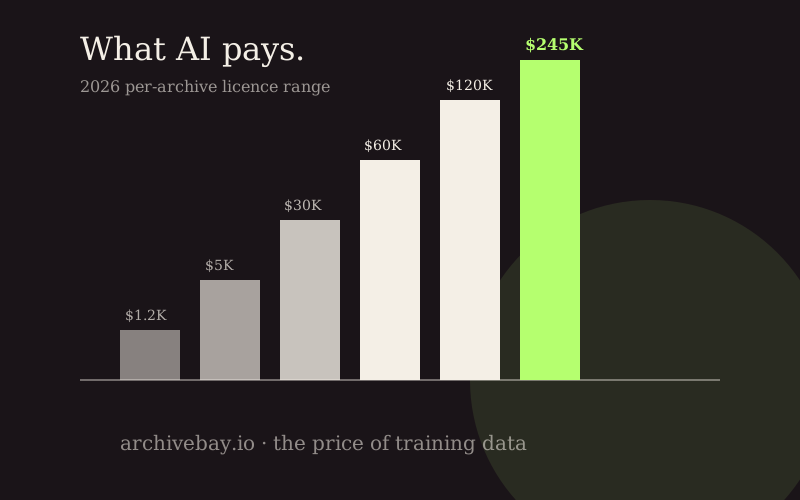
A practical, sourced reference for the price AI labs are paying for training data in 2026 — text, images, video, audio, and code — with deal comparables, per-unit rates, and the factors that move a number five-fold in either direction.
There is no published price list for training data. The deals are private, the press numbers are rounded to the nearest absurd-sounding billion, and most "pricing analyses" online quote a $5–250 million range without distinguishing between a single specialist licence and a five-year exclusive deal with a multi-billion-dollar publisher.
This is the unromantic version. What AI companies pay for training data in 2026, by content type, per unit, with sources. If you're a creator deciding whether to licence your archive, or a buyer trying to benchmark a deal, this is the reference page.
The short answer
The headline ranges, by content type and licence shape, in mid-2026 dollars:
| Content type | Per-unit rate (non-exclusive, 12mo) | Per-corpus deal range |
|---|---|---|
| News & long-form text | $0.05–$2.00 per article | $5K – $250M |
| Academic papers | $1–$50 per paper | $1M – $25M |
| Podcast transcripts | $0.10–$3.00 per minute | $10K – $5M |
| Stock video | $1–$4 per minute | $100K – $25M |
| Stock photo | $0.10–$2.00 per image | $50K – $50M+ |
| Code | $0.01–$0.50 per file | $50K – $10M |
| Reddit-style social/forum text | $0.001–$0.01 per post | $30M – $60M/yr |
These are real numbers from deals signed between mid-2024 and mid-2026. The ranges look wide because the underlying inputs vary by an order of magnitude — but the inputs are predictable, and the rest of this post is the breakdown.
What moves the number
Five variables decide where on the range a particular archive lands.
- Scarcity. Content already in Common Crawl is largely worthless to a buyer — they have it for free. Content behind a paywall, a login wall, a private RSS feed, or simply too obscure to have been crawled is worth materially more. We have a free check that tells you which side you're on.
- Provenance. Whether the buyer's lawyer can sign off on chain-of-title in a single afternoon, or has to spend a quarter chasing rights statements through three subcontractors. Clean provenance is the difference between a deal that closes and one that dies in legal review.
- Quality. Edited human writing > LLM-generated text. Transcribed long-form audio > raw podcast files. Curated > raw. AI labs have started filtering aggressively for quality because low-quality data is now a net negative on model performance.
- Volume — but not in the way you think. Big archives close bigger deals, but per-unit rates fall with volume. A single 500-item specialist archive will price at $5–30/item. A 500K-item archive of similar quality will price at $0.50–3/item. Don't bundle out of insecurity; bundle only if the buyer needs the scale.
- Exclusivity. Exclusive licences are 3–5× the price of non-exclusive ones. Most creators sell non-exclusive because the maths almost always works out better: a $10K non-exclusive cheque you can sign with three buyers is more valuable than a $30K exclusive cheque from one.
News and long-form text
The headline market. The deals that have set the comparables:
- News Corp / OpenAI — $250M over five years, training + reference, broad catalogue (WSJ, Times, Sun, etc.)
- Axel Springer / OpenAI — reportedly ~$10M/year, multi-year, multi-publication
- Vox Media / OpenAI — multi-year, undisclosed, covers The Verge / New York Magazine / others
- The Atlantic / OpenAI — multi-year, mid-eight-figure range
- Financial Times / OpenAI — multi-year, undisclosed
- News Corp / Microsoft (separate) — multi-year, undisclosed
- DotDash Meredith / OpenAI — multi-year, undisclosed (covers People, Better Homes, etc.)
For independent creators, the per-article rate sits between $0.05 and $2.00, depending on:
- Specialism (medical, legal, financial, scientific writing prices materially higher than general commentary)
- Length (long-form > short-form, sometimes by 5×)
- Whether the work has been edited (edited > raw drafts > comments)
- Scarcity (paywalled > public)
A 500-article specialist newsletter with 5 years of focused expertise typically lands at $5K–$30K for a non-exclusive 12-month licence. A 5,000-article major archive can land in the $60K–$245K range. The big-publisher per-article rates implied by the deals above are higher than the independent-creator rates — economies of scale and brand premium go the other way at the top end.
Academic papers
The most under-priced category until 2024, the fastest-rising in 2025–26.
- One academic publisher (named in litigation discovery) — $23M one-time for its previously published research corpus
- Several university presses — multi-year deals with major labs, undisclosed, reportedly in the $1–10M range each
- Wiley — multi-year licence with Microsoft, undisclosed (reportedly ~$23M/year)
Per-paper rates run $1–$50. The variation is almost entirely about specialism: biomedical research, financial economics, and primary scientific data sit at the top; humanities and review papers sit at the bottom.
For independent academics — postdocs, sabbatical lecturers, retired researchers with paper-collection rights — the path is usually through a marketplace, not direct outreach, because the per-creator volume is too small to interest the direct procurement teams.
Podcasts (with transcripts)
A transcripted podcast catalogue is more valuable than the raw audio in 2026. The transcripts are training data; the audio is sometimes useful for speech-model training but the per-minute rates are lower.
Per-minute rates for transcripts: $0.10–$3.00. The variation:
- Specialism — investing, medicine, science, business: $1–3/min. General-interest commentary: $0.10–0.50/min.
- Speaker diversity — interview shows with named experts have higher per-minute rates than monologue shows
- Length per episode — long-form (>40 min) prices higher per minute than short-form
A 5-year specialist podcast with 250 episodes averaging 60 minutes is 15,000 minutes of transcript. At $1/min that's a $15K licence; at $3/min it's a $45K licence. Add in the back-catalogue rarity premium (most podcasts aren't transcribed at all, so the marginal value of a clean transcripted corpus is higher than most podcasters realise) and the range extends to $80K for top specialist shows.
For the raw audio market — speech-model training — the rates are $0.05–$0.50 per minute. Lower, but worth surfacing as a separate licence if the catalogue is large.
Video
The 2025–26 explosion. AI video models (Sora, Veo, Runway, Pika) need vast amounts of training footage and have been buying aggressively.
- Shutterstock / OpenAI — multi-year, multi-deal, undisclosed sums (reportedly cumulative $50M+)
- Photobucket — reportedly $1–2 per photo at a billion-image catalogue scale; separate video terms reportedly running $4–8/min for premium content
- Various stock-video sellers — $1–$4 per minute is the public range, with 4K, drone, 3D animation, and rare-subject footage commanding $5–15/minute
For independent video creators with reasonably large catalogues (>50 hours), the path is typically through an aggregator (Defined.ai, Datavant, others) rather than direct, because video buyers want bundled access at scale.
For YouTube creators specifically: rights are the friction point. Standard YouTube terms have historically given Google broad usage rights that may complicate licensing the same content separately. Get a lawyer to look at this before quoting a price; if you're under a partner-programme agreement, the answer depends on which version of which programme you signed.
Photo
The Photobucket and Shutterstock deals set the per-image market. The headline ranges:
- Stock photo, non-exclusive training licence: $0.10–$2.00 per image
- Premium / model-released / curated stock: $1–$5 per image
- Rare specialist photography (medical imaging, satellite, scientific): $2–$50 per image
For independent photographers with focused-niche catalogues — wildlife, architecture, food, fashion — the marketplace path tends to outperform direct outreach because the per-photographer volume rarely meets the threshold for direct AI-buyer attention.
Code
The smallest and least transparent market. Public GitHub is free training data and the major labs have already consumed it. What buyers pay for now is private code corpora — internal repos, customer-support transcripts, code-with-attached-documentation, and labelled data.
- GitHub Copilot training — built primarily on public GitHub; no creator royalties
- Smaller specialist code marketplaces — $0.01–$0.50 per file, with rare-language and rare-framework code at the top end
If you're an independent developer with a large private code corpus you can legitimately licence, the path is direct outreach or a specialised broker, not a general-purpose marketplace.
Social and forum text
Reddit and Quora set the comparables. Both are big-corpus deals at the platform level, not individual-creator deals:
- Reddit / Google — $60M/year, multi-year
- Reddit / OpenAI — multi-year, undisclosed
- Stack Overflow / OpenAI — multi-year, undisclosed
- Tumblr / Midjourney — undisclosed
Per-post rates are essentially negligible — $0.001–$0.01 — but the corpus volumes are vast. For individual creators, this category isn't directly accessible; you'd have to bundle through a platform.
What independent creators should actually do
The five-factor model and the seven content-type tables are the whole reference. To turn it into an actual cheque:
- Identify what you have. Pull the count of items, the date range, and an honest sense of specialism. Use a spreadsheet.
- Use the valuation tool — it applies the model in the table above to your specific archive and returns a price range in 30 seconds.
- Check scrape status — the answer changes your strategy. If you're in Common Crawl, scarcity premium is gone; if you're not, it's a multiplier.
- Decide on the path — direct outreach (slow but high-touch), broker (faster but margin), or marketplace (fastest for the $1K–$200K segment). For most independents, a marketplace like ArchiveBay is the right path because the alternatives have implicit costs that the friendly framing on a "$X/year" deal rarely accounts for.
The market is real. The numbers are larger than most creators realise. The deals are happening every week. The reference page above is your starting point; what makes a real cheque happen is actually pricing your archive, packaging it cleanly, and listing it where buyers can find it.
Sources for the deal comparables in this post draw on litigation discovery, press disclosures, and industry reporting between mid-2024 and mid-2026. Numbers cited as "reportedly" reflect press accounts of deals where formal confirmation hasn't been issued.