May 10, 2026 · 5 min read
How AI companies should be paying creators
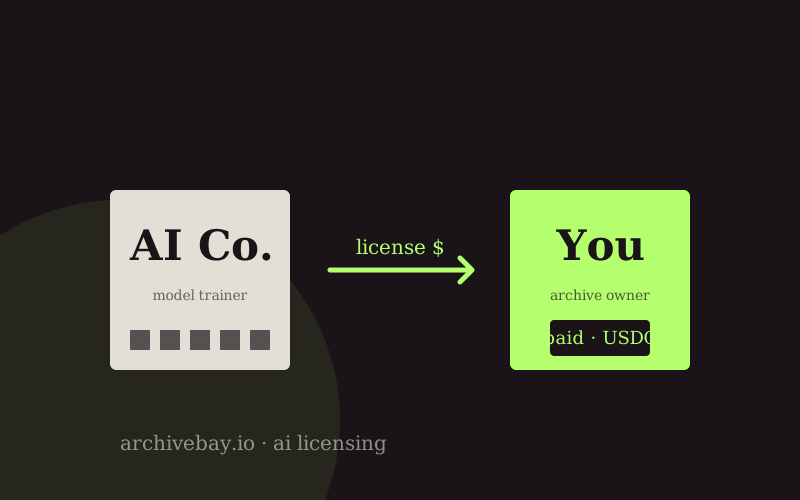
The current model — scrape everything, settle in court later — isn't going to last. Here's what the working version of AI content licensing actually looks like.
The default deal between AI companies and the people who made the internet is that there is no deal. AI companies scrape the web, train models on what they find, and tell anyone who asks that this is fine because it has always been fine.
This has worked for them in the courts, mostly. It is not working in public, and it is not going to work much longer.
What replaces it should be obvious — a real licensing market, with prices, contracts, and proof. The reason that market doesn't exist yet is not that AI companies refuse to pay. The reason is that there is no infrastructure for paying anyone except large publishers with lawyers.
The current shape of the problem
Today, an AI company that wants to license content has three options.
The first is the AP option — sign a big contract with a big publisher and pay millions of dollars a year. This works because the publisher can produce neat legal proof of ownership, can sign in one shot for an entire archive, and can credibly threaten litigation if the deal is breached.
The second is the Reddit option — buy a platform with a corpus on it, and license the whole platform at once. Same logic. Big counterparty, one contract, clear ownership.
The third is the silent option — scrape everything, hope no one sues, settle the cases that get filed. This is what most AI companies have done for most of the last five years, and it has worked because most individual creators cannot afford to sue.
What is missing is the middle. There is no way for an AI company to write a check to a single independent journalist for the use of her newsletter archive. Not because the AI company doesn't want to — paying her two thousand dollars is rounding error compared to the legal risk — but because the infrastructure doesn't exist. You can't run a hundred-thousand-creator licensing operation as a bunch of bespoke contracts.
What the working version looks like
The working version of AI content licensing has three properties.
It is standardized. Every license uses the same legal terms. The buyer doesn't negotiate. The creator doesn't draft. They pick from a small menu — training, retrieval-augmented generation, research, perpetual, time-limited — and the price scales accordingly.
It is verifiable. The buyer can prove they own the right to use the content if challenged. The creator can prove the content was actually theirs to license. The terms are recorded somewhere immutable so no one can argue later about what was agreed.
And it is automatic. The AI buyer doesn't email the creator. The creator doesn't draft an invoice. A purchase on the platform triggers payment and access in the same transaction. This is the only way the unit economics work for individual creators — if every license requires a human conversation, no one will license to anyone who isn't already a big publisher.
Why on-chain settlement matters here
A lot of the on-chain talk in this space sounds like blockchain-for-its-own-sake. Most of it is. But there are two specific places where on-chain infrastructure actually solves a problem that is hard to solve any other way.
The first is proof of license. When you license a piece of content to an AI company, you want a public, tamper-proof record that the license was issued. Not because you don't trust the company today, but because in three years, when the company has been acquired, the contract has been lost, and a regulator is asking who is licensed for what, the only record that survives a corporate transition is one that is public and not stored in the company's own systems. An on-chain record is the cheapest way to get that.
The second is stablecoin settlement. Paying small creators globally is hard. International wires are slow and expensive. Stripe doesn't work in half the countries you want to support. PayPal is fine but takes a cut and freezes accounts. Stablecoins on a fast chain settle in seconds, work everywhere, and have low enough fees to make a hundred-dollar payment economically reasonable. For the platform to work at the scale of "every newsletter operator on earth," settlement has to be this cheap.
Neither of these properties requires anyone to care about crypto. They are plumbing.
The thing that has to change
The piece that doesn't exist yet, and that has to exist for any of this to work, is the basic act of giving an individual creator legal standing.
If you are a New York Times reporter, your lawyer is the New York Times. If you are an independent writer on a personal Substack, your lawyer is nobody. You can't realistically sue an AI company for scraping you, even if you can prove they did, because the cost of the lawsuit exceeds any damages you would ever recover. So your work is free in practice no matter what the copyright law says in theory.
A licensing platform fixes this not by giving you a lawyer, but by making the license itself enforceable without one. If the AI company has signed a public, on-chain license — the same license they sign with every other creator on the platform — then breaching that license is no longer a small individual matter. It is a violation that every other licensor on the platform can point to. The legal leverage comes from the standardization, not the headcount.
That is the thing the AP has and the individual writer does not. And it is the thing a platform can give back.
Where this is going
The boring prediction is that within five years there will be a real market for AI content licensing, and it will look more or less like the music licensing market — a small number of platforms, a standardized rate card, automatic payment, and the assumption on all sides that you license your work the way you license your music.
The interesting prediction is that the rate card will be a lot higher than people expect, because clean training data is becoming the most scarce input in the entire AI stack, and the supply is finite. The AI companies that adapt to this fastest will eat the ones that don't.
The unboring prediction is just: if you have an archive, list it. Whether or not anyone buys it tomorrow, the existence of the listing is what creates the market.