Jun 13, 2026 · 9 min read
How to sell your newsletter, podcast, or blog to AI companies
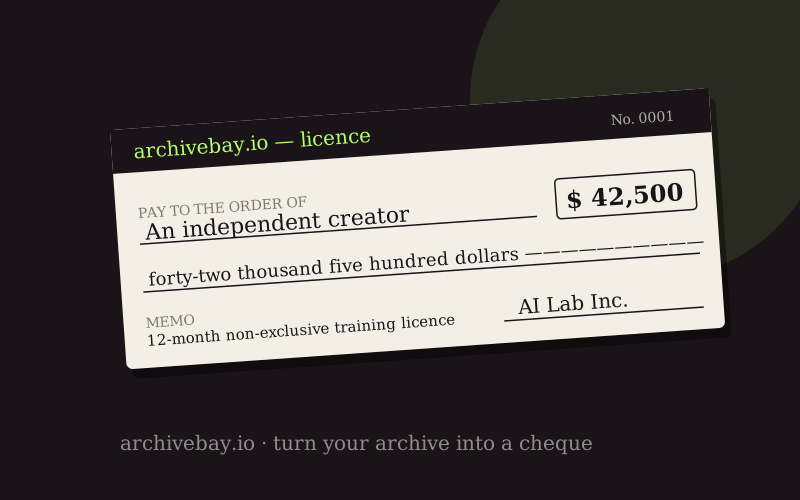
The practical playbook for licensing your archive to AI labs — what they want, what they'll pay, who to talk to, and the boring legal mechanics that turn a five-year body of work into a real cheque.
In 2026, AI companies are paying for training data. Not in theory and not in the future — right now, on signed agreements, in dollar amounts that range from low-thousands for a single-newsletter licence to $23 million for a single academic-publisher catalogue. The deals are happening. The only question is whether yours is on the list.
If you write a newsletter, run a podcast, post videos, or publish a blog — and you own the rights to your back catalogue — this is the practical guide to converting that archive into a paid licence.
The short answer
Three things have to be true:
- You own the rights. Whatever platform you publish on, you need a clean rights position on the content itself. For most independent creators, this is already true. For platform-staff writers, it usually isn't.
- The archive is scarce. AI buyers pay for data they don't already have. If your work is in Common Crawl or already scraped, the marginal value to a buyer drops. Work behind a paywall, members-only feed, or login wall is worth more.
- It's packaged in a way a buyer can use. Buyers want clean, structured, attributable text or transcripts with clear licensing terms — not a 4 GB tarball of WordPress export.
If all three are true, the path to a licence is shorter than you think.
What AI companies are actually buying
A good way to understand this market is to look at the deals already disclosed:
- The Atlantic — multi-year licence with OpenAI, mid-eight-figure range
- Vox Media — OpenAI licence covering The Verge, New York Magazine, and others
- Axel Springer — OpenAI licence, reportedly ~$10M/year
- Financial Times — OpenAI licence, multi-year
- News Corp — $250M five-year OpenAI licence (the headline number that re-priced the whole market)
- Reddit — $60M/year Google licence
- Shutterstock — multi-year, multi-deal data licensing programme spanning OpenAI, Meta, and others
- Photobucket — reportedly negotiating $1–2 per photo at a billion-image catalogue scale
- A leading academic-paper publisher — $23M one-time payment for previously published research papers
- Apple's training-data programme — reportedly $50M over multi-year periods to publishers
For independent creators with smaller archives, the comparables are smaller but exist:
- Independent newsletter operators, $50K–$200K range, multi-year non-exclusive licences
- Podcast networks, low-six-figures for the full transcribed catalogue plus future content
- Specialist bloggers with 5–15 years of focused-niche output, $5K–$50K for non-exclusive licences
The pattern: buyers pay for rarity, depth, and quality, not raw quantity. Twenty years of focused expertise is worth more than five years of broad commentary.
What buyers actually want from you
The single most useful thing you can do before a conversation with an AI buyer is to read what they want like a procurement manager.
Clean text. Most archives are HTML with menus, ads, footers, related-content widgets, comment threads, and tracking pixels embedded in them. A buyer wants the article text, separated from the surrounding chrome, in a parseable format. The work to clean this up is real, and it's worth doing before any conversation — both because it makes you easier to buy from and because it gives you a defensible inventory count.
Attribution. Buyers want to know who wrote what, when, under what licence, with what edits, and against which version. The cleanest archive in the world is worth less if a buyer can't tell whether a piece was authored by you or guest-authored by someone you no longer have rights to.
Rights provenance. A signed statement, ideally with cryptographic timestamps, that the content was created by you, on this date, with no encumbrances. This is the friction point that most independent creators stumble on, and it's the entire reason ArchiveBay's on-chain provenance system exists — to do this part for you so a buyer's lawyer has a clean record to point at.
Volume. Not in the sense of "more is always better" — see the rarity point above — but in the sense that a 5,000-item archive is closer to the minimum interesting size for a serious buyer than a 50-item one. Bundle with other creators if your individual archive is small.
Licence type. Buyers price differently based on what they're allowed to do. The two main shapes are:
- Training-only: the buyer can use the content to train models, but cannot reproduce it. Lower price.
- Training + reference: the buyer can also surface the content in retrieval-augmented systems with attribution. Higher price.
Exclusivity is the other axis. Exclusive licences are 3–5× the price of non-exclusive ones; most creators sell non-exclusive because the maths almost always works out better.
What you'll get paid
The real number depends on the four factors covered in detail in How much is your content worth to AI? — size, age, content type, and scarcity. A rough sense for the 2026 range:
| Archive shape | Indicative range per non-exclusive licence |
|---|---|
| Small focused newsletter (2 yr, 100 items) | $1.2K – $5K |
| Medium archive (5 yr, 500 items) | $5K – $30K |
| Specialist podcast w/ transcripts (5+ yr) | $15K – $80K |
| Decade-long focused blog | $25K – $150K |
| Major archive (10+ yr, 3K+ items) | $60K – $245K+ |
These are non-exclusive, training-only, 12-month licences — the most common shape. Exclusive licences and training-plus-reference licences are higher.
The free valuation tool at /estimate gives you a per-archive range in 30 seconds. Run it before you talk to anyone.
The path to a licence
There are basically three paths.
Path A — direct outreach to AI companies
This is the path the big publishers used. It works if you have a recognisable brand, a large archive, and the time to navigate procurement. The realistic steps are:
- Identify the right team. At the major labs the relevant teams are usually called Data Partnerships, Content Licensing, or Strategic Data. Names you can find on LinkedIn.
- Send a tight one-pager. Archive size, date range, content type, sample, what you're offering (non-exclusive training licence), what you're not offering (exclusive, reference rights), and a price range.
- Negotiate. Expect 4–8 weeks. Expect their first offer to be 30–50% of your asking range.
- Sign and deliver. This is where the rights-provenance friction usually appears: their lawyers will want a clean chain-of-title statement.
This path works. It's slow, and it doesn't scale if you're not full-time on it.
Path B — through a data broker or aggregator
A handful of companies — Defined.ai, Datavant, Calliope.ai, and others — aggregate creator archives and sell bundled access to AI buyers. The broker takes 20–40% of the deal value. They handle outreach and contracting. You get speed; you give up margin.
This works well for content that's commoditised, less well for distinctive specialist archives where you'd rather hold the relationship.
Path C — through a marketplace
The newer, faster-moving path: list your archive on a marketplace where AI buyers can discover it, get a price, and licence directly without bilateral negotiation on each deal. This is what ArchiveBay does — a 1% platform fee, 99% to you, with on-chain provenance handled automatically so the buyer's lawyer has the chain-of-title document they need.
The trade-off: marketplaces work better for the $1K–$200K segment than for the $1M+ segment, where direct negotiation usually still nets a higher cheque. For most independent creators, the marketplace path is the right one because the alternative — multi-month outreach to companies that may not respond — has an implicit cost too.
The legal mechanics nobody mentions
Three documents matter. They are not optional, but they are not hard.
1. A representations-and-warranties statement. You confirm that you own the rights, that no third-party content is included without permission, and that you'll indemnify the buyer if either turns out to be false. Most independent creators can sign this honestly. Where it gets uncomfortable is around guest posts, embedded media, and licensed images — be specific about what's not included.
2. The licence grant itself. What can the buyer do with the content, for how long, in what territory, and on what exclusivity basis. The licence grant is the commercial part of the deal; everything else is paperwork around it.
3. A delivery mechanism. Usually a one-time bulk download or an authenticated API endpoint. ArchiveBay handles both — once a licence is signed, the buyer gets an API key and the data is theirs to use under the licence terms.
The reason ArchiveBay can move quickly is that the contract structure is identical across deals (a standard Master Content License Agreement), the provenance is automatic, and the delivery is templated. The legal paperwork that takes Vox Media a quarter to negotiate with OpenAI is largely the same paperwork you'd negotiate with a buyer — just with more layers. Standardising it is what compresses the time-to-cheque from months to days.
What to do this week
If you're a creator with an archive and you're thinking about this for the first time:
- Audit your back catalogue. Count items, date range, content type. A spreadsheet is fine. The number itself is what unlocks the pricing conversation.
- Run the valuation tool. Get an honest price range.
- Run the scrape check. Find out what's already been taken. This tells you which parts of your archive are scarce (worth more) and which are commoditised (worth less).
- List on a marketplace. If your archive is in the $5K–$200K range, this is by far the fastest path to a real cheque. ArchiveBay is built for exactly this segment.
- Set a paywall on new work. Whatever you publish from now on, keep some of it scarce. Public-by-default is the default revenue-zero option.
The market for paid training data is real and growing. The deals that have been signed in the past 18 months are the floor, not the ceiling. The creators who treat their archives as assets — not just promotional surface — are the ones who are going to come out of this decade with a cheque to show for the work.
If you're ready to see what your archive is worth, take 30 seconds to run the free valuation tool. If you want a faster path to a licence, list your archive on the marketplace — 1% platform fee, 99% to you.