May 4, 2026 · 4 min read
What on-chain provenance actually means for content
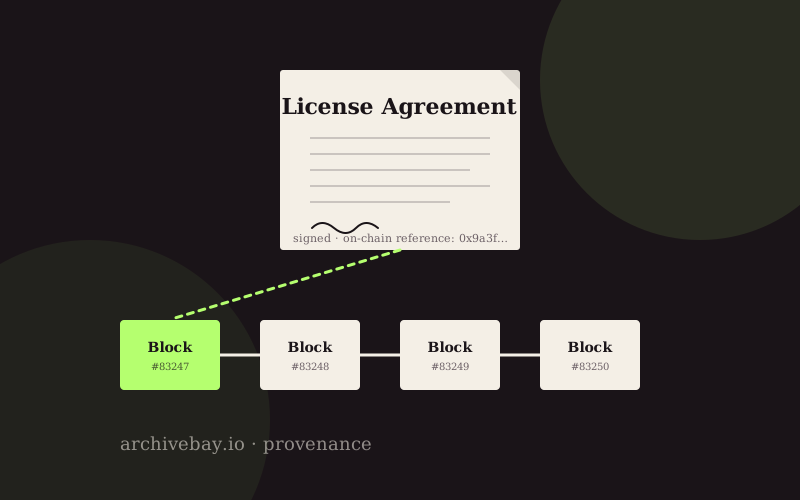
It's not about crypto. It's about having a record of the deal that doesn't disappear when the company that issued it does.
When people hear "on-chain licensing records" they tend to react in one of two ways. Either they assume it's some kind of NFT scam, or they assume it's meaningless ceremony — a fancy way of saying "we wrote it down." Both reactions are wrong, but neither is unreasonable, because nobody has explained what the record actually is.
So here is what it is.
A license is a contract. The on-chain entry is the proof.
When an AI company licenses your archive, two things happen at the same time. They get the right to use your content. You get paid.
The license is the legal artifact — the document that says what the buyer can do, for how long, under what terms. The on-chain entry is the proof that the license was issued. They are not the same thing. The license is the contract. The on-chain entry is the signature on the contract that nobody can later erase.
In a normal commercial transaction, that proof lives in the seller's accounting system and the buyer's records. If either party is sued, the records are produced as evidence. This works fine when both parties are stable companies that will exist for a long time and keep careful files.
It works less well when the buyer is a tech company that may be acquired, dissolved, or have its records destroyed by the time the dispute matters. It works much less well when the seller is an individual creator whose entire record of the transaction is one email and a Stripe entry.
Writing the proof to a public chain solves this by putting it somewhere that nobody owns and nobody can edit. Not the seller. Not the buyer. Not the platform. The record is a public fact, like the height of a mountain.
What the record contains
On ArchiveBay, every license generates a small piece of structured data and submits it to the Solana network. The data includes:
- The license ID, which uniquely identifies the deal
- A hash of the archive manifest — a fingerprint of exactly which content is covered, so the buyer can't later say "we thought we were licensing the whole back catalog" and the seller can't say "I only meant the recent stuff"
- The buyer's identifier and the creator's identifier
- The price paid, the platform fee, the creator's payout
- The license type and the expiration date
That blob is signed by the platform and submitted as a Solana Memo Program transaction. The chain confirms it. The transaction signature becomes the permanent reference.
Anyone, ever, can verify that record by querying the Solana network and reading back the data. There is no API to break, no company to subpoena, no log files to lose. The entry is on every full Solana node on earth.
What the record does not prove
It does not prove that the AI company used the data in the way the license allows. It can't. The on-chain entry is about the transaction, not the downstream use. If the buyer trains on the data and then re-trains a separate model with the same data outside the license terms, the chain doesn't catch that.
It does not prove the content was actually owned by the seller. That is a separate verification — ArchiveBay does it before the listing goes live, by checking API access, OAuth, DNS, or RSS-feed signals. The on-chain record reflects the result of that verification, but it doesn't perform it. Garbage in, garbage out applies.
And the on-chain entry is not the license itself. The legal document is stored off-chain, because legal documents are long, formatted, signed by lawyers, and need to be readable in court. The on-chain piece is a pointer to that document, a hash of its content (so you can prove the document hasn't been altered), and the structured metadata about the deal.
Why this matters now and not in 2019
In 2019, this would have been theatre. There were almost no AI content licensing deals, the legal environment was a free-for-all, and writing things on a blockchain was mostly a way to get an internet stranger to send you cryptocurrency.
In 2026, the situation is different. The EU AI Act requires AI companies to disclose the data they trained on. Several countries are following with their own versions. American class-action suits against AI companies are working through the courts, and the discovery in those cases is expensive precisely because nobody kept good records of what was scraped from whom. Regulators are about to demand the records that nobody kept.
A platform that produces public, immutable proof of every license as a side-effect of every transaction is, accidentally, the cheapest possible compliance regime for the AI industry. The records were never going to exist. Now they do, automatically.
That is what on-chain provenance for content actually means. Not crypto-as-an-end. Crypto as a place to put records that need to survive longer than the companies that issued them.