Jun 13, 2026 · 7 min read
What OpenAI, Anthropic, and Google pay publishers for training data
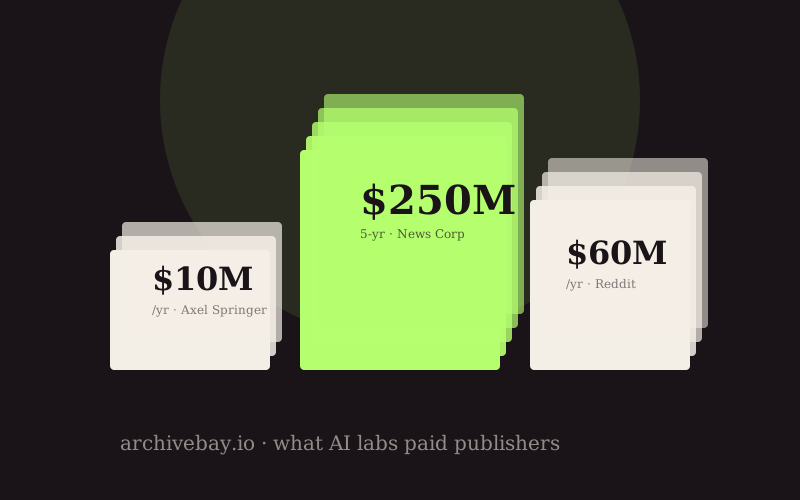
A sourced reference to the major publisher-AI deals signed between 2023 and 2026 — News Corp, The Atlantic, Reddit, Vox, Axel Springer, FT, Wiley, and the rest — with deal values, structures, and what the comparables imply for independent creators.
The AI training data market is measured in billions as of mid-2026, and most of the spend has gone to a small number of large publishers. The deals are mostly disclosed in part — a quarterly earnings call, a press release, a lawsuit discovery filing — and the headline numbers do the work of repricing the entire market. This is the sourced reference to what the major AI labs are actually paying publishers, deal by deal, with the structure of each agreement and what it implies for the creators who don't have a quarterly earnings call.
The short answer
The disclosed and reported AI–publisher deal flow, sorted by buyer:
OpenAI
The most active publisher buyer in 2024–26 by a wide margin.
- News Corp — $250M over five years, broad licence (WSJ, NY Post, Sun, Times of London, others). Includes both training and real-time content access.
- Axel Springer — multi-year, reportedly ~$10M/year, covers Bild, Welt, Politico, Business Insider.
- News Corp / Microsoft (separate deal) — multi-year, undisclosed value.
- The Atlantic — multi-year, mid-eight-figure range (reportedly).
- Vox Media — multi-year, covers The Verge, New York Magazine, Vulture, Eater, others.
- Financial Times — multi-year, undisclosed value.
- Le Monde — multi-year licence with French-language publisher Groupe Le Monde.
- Prisa Media — multi-year, Spain.
- Time — multi-year, includes archive going back 100+ years.
- Hearst — multi-year, covers Cosmopolitan, Esquire, Harper's Bazaar, Town & Country, Runner's World, Car and Driver, others.
- DotDash Meredith — multi-year, covers People, Better Homes, Investopedia, others.
- Reddit — multi-year, undisclosed value (separate from the Google deal).
- Stack Overflow — multi-year, undisclosed.
- News/Bild — multi-year, undisclosed.
OpenAI's typical deal structure: multi-year, training rights + reference rights, mid-seven to mid-eight figures depending on archive size. The News Corp deal at $50M/year for five years is the high-water mark.
A smaller number of large deals.
- Reddit — $60M/year, multi-year. Real-time access plus training data.
- Various publishers — Google has been less active publicly than OpenAI, but multiple undisclosed publisher deals exist, and the company runs significant in-house licensing through its existing Google News Showcase programme.
Anthropic
Historically more focused on synthetic data than commercial licensing, but the picture has shifted in 2025–26 with Claude 4 and 4.5.
- Various publishers — Anthropic does not disclose deal flow publicly. Industry reporting suggests a smaller number of deals than OpenAI but in the same per-deal range. Anthropic's settlement of the Books3 / Authors Guild class action included payments to plaintiff authors that established a precedent value around $3,000 per book.
Microsoft
Often co-bundled with OpenAI deals where Microsoft is the downstream consumer.
- News Corp — multi-year, separate from the OpenAI deal.
- Wiley — multi-year, reportedly ~$23M/year, covers academic publishing portfolio.
Apple
Late entrant. Reportedly running a $50M-over-multi-year publisher programme as of late 2025.
- Various publishers — Conde Nast, NBC News, and other publishers have been named in press reporting; specific terms are undisclosed.
Amazon
Active in 2025–26 across both publisher and broader data licensing.
- Various publishers — Reuters, Slate, and a handful of others have been named in press reporting; specific terms are undisclosed.
Meta
Less active publicly than the others — Meta has historically preferred to train on its own platform data (Facebook, Instagram) plus public-web scrape — but began commercial publisher licensing in 2025–26.
- Reuters — multi-year licence announced in 2024.
- Various others — undisclosed.
Adobe, Shutterstock, Getty
The image and video side, which is a separate market structure (per-asset rather than per-corpus) but worth surfacing alongside the text deals because the underlying customer base is the same AI labs.
- Shutterstock — has signed deals with OpenAI, Meta, Apple, and others. Reported cumulative deal value above $200M across the suite as of 2025.
- Getty Images — operates a permissioned-AI training licence at the asset level; smaller upfront fees but recurring royalty structure.
- Adobe — runs the Firefly training set internally; commercial-content contributors receive opt-in royalty programmes.
The patterns that matter
Pulling back from the deal list, four patterns to notice.
1. The deal structure has standardised
The 2023 deals (early Microsoft–Bloomberg / OpenAI–AP Press) were bespoke. The 2024–26 deals are largely standardised: 3–5 years, training rights + retrieval rights, all-you-can-eat per-corpus access, mid-seven to mid-eight figures depending on archive size and brand. The legal teams at OpenAI and Microsoft are now running these as repeatable templates.
The implication for independent creators: the standardisation that lets News Corp close a deal in a quarter also lets a small newsletter close a deal in days, on the same legal template. The legal work that takes Vox Media a quarter to negotiate is largely the same legal work that would take you a week — just with fewer commas and a smaller cheque.
2. The per-publisher rate is flat to declining
The $50M/year News Corp deal in 2024 has been described by some industry observers as the high-water mark and a slight overpay; the $10M/year Axel Springer rate has settled in as the more sustainable baseline. The labs are not going to keep paying tens of millions per publisher indefinitely — the model is moving toward broader and cheaper aggregated licences rather than ever-bigger named-publisher deals.
For independents, this means the window for premium per-creator pricing is now. The first cohort of independent licensors gets the better deals; the long tail will get aggregated rates.
3. Reference rights matter more than training rights
Most of the high-value 2025–26 deals include not just training rights (the AI lab can train its model on the content) but reference rights (the AI lab can retrieve and surface the content in real-time responses, with attribution, in retrieval-augmented systems). Reference rights are roughly 2× the price of training rights alone, and they're where the future of monetisation is going.
The implication: when you negotiate or list a licence, think about whether you're selling training-only or training + reference. Reference licences are more valuable because they include an attribution surface — your name and link appear next to the model's response. Some creators choose training-only because they don't want their work surfaced as a model answer; others choose training + reference because attribution is its own marketing channel.
4. Academic content has been catching up fast
The original 2023 deal flow was almost entirely news/general-publisher. The 2025–26 wave has shifted toward academic content — Wiley, Elsevier, university presses, and large repositories of research papers — because the major labs have realised that high-quality factual content from peer-reviewed sources improves model performance more per unit than the equivalent volume of news commentary.
For independent academics — postdocs with paper-collection rights, retired researchers, specialist niche-domain bloggers — this is a tailwind. Per-paper rates have been rising every quarter through 2026 and the trend looks durable.
What this means for an independent creator
The deal table is enormous, the numbers are large, and almost none of it is directly accessible if you're not running a publisher with a procurement team. The takeaways that are directly applicable:
- The deals are real. AI labs pay for training data, with signed contracts and standard legal frameworks. The market is not a future possibility — it's a current cash flow, and it's been a cash flow for two years.
- The per-corpus rates the major publishers get are higher than what an independent licence will fetch. But the path to a deal is shorter — no procurement team, no quarterly negotiation cycle, no lawyers on retainer billing $1,500/hour.
- The standardisation of contract structure is the lever. Once the legal template is set, the cost of marginal deals drops to near-zero. That's why a marketplace like ArchiveBay can move a smaller cheque from "list" to "signed and paid" in days rather than months.
- The window for premium per-creator pricing is now, not later. The labs are moving toward aggregated rates; the early independent licensors are getting the better deals before that consolidation happens.
If you're sitting on an archive — newsletter, podcast, blog, research-paper collection — and you've been waiting to see whether the AI licensing market is real before acting on it: the answer in the deal table above is yes, and the action is to either price your archive (free tool) or list it (free to do). Whatever you do, the part of your archive that's still scarce is becoming scarcer every month, and scarcity is the whole game.
All deal values cited are drawn from press reporting, SEC filings, court discovery, and industry analysis between mid-2023 and mid-2026. Where a deal is described as "reportedly," the figure reflects press accounts rather than formal confirmation by either party. We update this post when significant new deals are disclosed.